

Britain finally caught up to what Iranian dissidents knew all along
Washington Examiner, July 14, 2026, by Nasser Razii
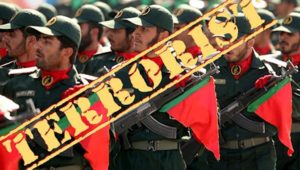
On Monday, the United Kingdom took one of the most consequential steps in its policy toward the Iranian regime by designating the Islamic Revolutionary Guard Corps as a terrorist organization. The decision criminalizes membership in, support for, or public promotion of the Guard in Britain and reflects a fundamental reassessment of the threat posed by the regime’s most powerful institution.
For many observers, the announcement appeared to be a dramatic policy shift. In reality, it was the culmination of years of parliamentary debate, growing security concerns, and mounting evidence of the Guard’s activities, as well as sustained advocacy by British lawmakers, security experts, Iranian human rights campaigners, and the organized Iranian Resistance led by the National Council of Resistance of Iran and its president-elect, Maryam Rajavi…
Long before many Western governments reached this conclusion, the Resistance Council had consistently argued that the Guard should be treated as a terrorist organization rather than as a conventional military force.
For more than a decade, Rajavi repeatedly called on democratic governments to proscribe the Guard, arguing that doing so was essential not only for international security but also for supporting the Iranian people’s struggle for freedom. Those calls became an integral part of the Council’s international advocacy and were consistently raised in meetings with parliamentarians, policymakers, and legal experts.
Read More
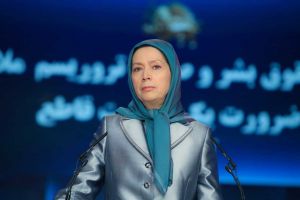 Maryam Rajavi’s Blueprint for Iran’s Future
The Ten-Point Plan for Iran’s Future was first presented by Maryam Rajavi, the President-Elect of the National Council of Resistance of Iran (NCRI), in December 2006 at a session of the Council of Europe. This plan encapsulates the aspirations of the Iranian people and the Iranian Resistance for a future Iran. This plan has been repeatedly recognized by resolutions from the U.S. Congress, several European parliaments, and prominent international figures as a vision for a free Iran.
1. Rejection of velayat-e faqih (absolute clerical rule). Affirmation of the people’s sovereignty in a republic founded on universal suffrage and pluralism;
2. Freedom of speech, freedom of political parties, freedom of assembly, and freedom of the press and the internet. Dissolution and disbanding of the Islamic Revolutionary Guard Corps (IRGC), the terrorist Qods Force, plainclothes groups, the unpopular Bassij, the Ministry of Intelligence, Council of the Cultural Revolution, and all suppressive patrols and institutions in cities, villages, schools, universities, offices, and factories;
3. Commitment to individual and social freedoms and rights in accordance with the Universal Declaration of Human Rights. Disbanding all agencies in charge of censorship and inquisition. Seeking justice for massacred political prisoners, prohibition of torture, and the abolishment of the death penalty;
4. Separation of religion and state, and freedom of religions and faiths;
5. Complete gender equality in the realms of political, social, cultural, and economic rights, and equal participation of women in political leadership. Abolishment of any form of discrimination; the right to choose one’s own clothing freely; the right to freely marry and divorce; and the right to obtain education and employment. Prohibition of all forms of exploitation against women under any pretext;
Read More
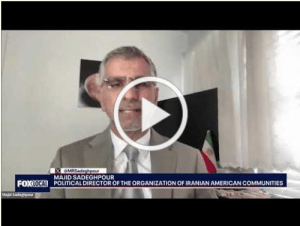 “Iranians caught between war and regime as ceasefire stalls” | @fox5dc
The real war in Iran has always been between the regime and the Iranian people.
In this interview, Dr. Majid Sadeghpour discusses the humanitarian crisis in Iran, the regime’s reliance on repression and conflict to stay in power, and why lasting peace and genuine change can only come through the Iranian people and their organized resistance. He also highlights the importance of supporting a democratic alternative that respects freedom, human rights, and the will of the Iranian people.
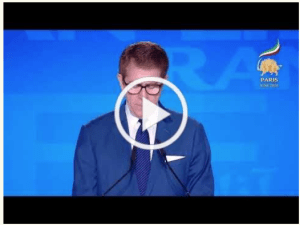 “Why Western media fell for Tehran’s disinformation on the MEK” | Ambassador Lincoln Bloomfield’s speech at the Free Iran 2026 Summit
Former U.S. Assistant Secretary of State Lincoln Bloomfield praised the Iranian Resistance as a credible democratic alternative led by Mrs. Maryam Rajavi. He rejected the regime’s propaganda against the NCRI and MEK, condemned decades of Western appeasement, and called on democratic governments to engage directly with the NCRI and support the Iranian people’s struggle for freedom, democracy, and a republic based on the NCRI’s 10-point plan.
OIAC Donation | 501 (c)(3) Tax deductible
Your donation will help OIAC advocate for a democratic, secular and non-nuclear government in Iran. Founded on the respect for human rights, gender equality, religious and ethnic tolerance, as wells as social, economic justice, and security for America. Our goal is to organize Iranian-American communities in the United States to promote these values.