

Pahlavi’s Iran ‘transition plan’ is an invitation for authoritarianism
American Thinker, August 15 2025 by Majid Rafizadeh
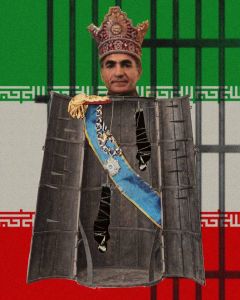
On August 1, 2025, Reza Pahlavi unveiled what he describes as a roadmap for Iran’s future — a document allegedly crafted by experts under his supervision and disseminated through NUFDI, his promotional apparatus. Marketed as a post-regime transition plan, it reads less like a democratic blueprint and more like a manual for consolidating unchecked power in the hands of a single unelected figure.
At the heart of the proposal lies an 18- to 36-month “Transitional Period,” which can be extended indefinitely. During this time, all branches of state authority would report to one man: the self-appointed “Leader of the National Uprising,” Reza Pahlavi.
The proposed “Transition System” comprises three entities: the National Uprising Body, the Transitional Government, and the Transitional Court — which, while superficially resembling the legislative, executive, and judicial branches, are in practice entirely subordinate to Pahlavi. He would appoint, oversee, and dismiss all members of these bodies at will, with no institutional constraints.
The so-called legislative arm, named Mahestan, is a hand-picked advisory council that echoes the aristocratic assemblies of ancient Iran — unelected and elite. The executive branch, including the head of government and all ministers, would be selected by Pahlavi and his inner circle. Even the judiciary would be shaped by his influence, with the chief judge nominated by his legislature and confirmed by him personally. In essence, the plan offers no elections, no checks and balances, and no independent judiciary — only the centralization of authority under one man.
Rather than dismantling the regime’s repressive infrastructure, the plan seeks to preserve and rebrand it. The Ministry of Intelligence would remain intact. IRGC personnel would be repurposed into “vetted” units, and anti-riot forces, the very tools of today’s brutal crackdowns, would be retained for “crowd control.” In twenty cities deemed “high-risk,” martial law would be imposed, and a newly created “special unit” with sweeping powers would report directly to Pahlavi, bypassing all bureaucratic oversight and civilian accountability.
Read More
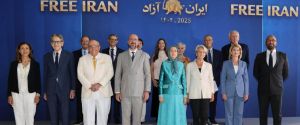
Maryam Rajavi – Free Iran Summit, Italy
Iran’s Path to a Democratic Republic- July 31, 2025
OIAC Donation | 501 (c)(3) Tax deductible
Your donation will help OIAC advocate for a democratic, secular and non-nuclear government in Iran. Founded on the respect for human rights, gender equality, religious and ethnic tolerance, as wells as social, economic justice, and security for America. Our goal is to organize Iranian-American communities in the United States to promote these values.