

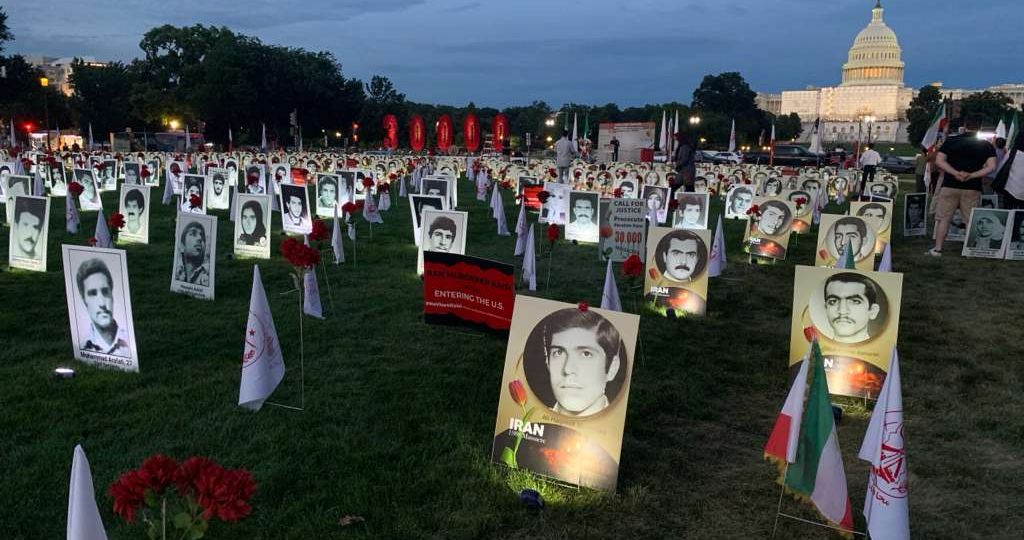
No. Killing of Khamenei nevertheless means the end of true Velayat Faghih (absolute clerical rule) in Iran. The new supreme leader lacks and will likely never achieve the hegemony his father enjoyed. The real ongoing war, one with tens of thousands of casualties, is inside Iran. Between the regime and people of Iran. For over 47 years, the free world basically watched as the regime in Iran massacred tens of thousands, including the massacre of over 30,000 political prisoners in the summer of 1988 to consolidate power. It watched as it matured a strategy of survival built not only on absolute internal oppression, but also on advanced ballistic missiles, support for international terrorism, drones, and yes, nuclear weapons. The very weapons it is blackmailing the West with today. The free world chose and still chooses to focus on Iran nuclear program in isolation, ignoring that the driving force will always be Medieval Islamic fundamentalism at the core of these strategies. The Western world, particularly Europe thus enjoyed the fruits of considerable economic ties with the regime while it; behind the scenes used the very technologies it bought, to advance those programs and strategy. They did not hold the regime accountable even though ample evidence was provided by Iran opposition that it is building a nuclear, ballistic missile, and advanced drone program. These date back to before 2002. Despite these warnings, particularly by the National Council of Resistance of Iran (NCRI), the JCPOA was signed without addressing Iran’s ballistic missile program.
Yes, the war has considerably weakened the regime and the IRGC but also forced the regime to make the latter a more prominent power broker. This is because the new Supreme leader lacks the political clout to consolidate power and make uniform decisions like his predecessors. The first supreme leader Khomeini needed war with Iraq to continue so that he could consolidate power and mobilize/empower IRGC in that manner to massacre dissidents. His replacement Khamenei ruled in the relative quite & in the aftermath of those massacres / apparent societal calm. It was that fake calm that fooled the free world into building most of the financial relationships that enabled the regimes’ clandestine programs named above (during the Clinton administration, they called this rapprochement “exchange of civilizations” while they as a goodwill gesture, even blacklisted Iran’s main opposition. Yet the killings in Iran and resistance to the regime never stopped.
Then came the repeated nationwide uprisings of the past 10 years, weakening Khamenei. This included the Women, Resistance, Freedom uprising of 2022, and the regime need to create external distraction – the regime’s role in the October 7th, 2023, attack in undeniable. Yet the aftermath saw the regime trying to regroup both internally and manage the downward spiral externally.
The current war has wounded the regime but an outside force with bombings will be unable to get rid of this regime or compel it back down. Its DNA prevents such a transformation. The regime is more like an onion with many layers, uprooting of which requires the Iranian people and an organized internal resistance.
The talk about monarchy in Iran is mostly noise and an impediment for real change in Iran. Worst, he may in fact be a colonial/fundamentalist regime project. The regime in Iran knows well that people have long ago dislodged Western crony monarchy and will never tolerate another. It also knows that Reza Pahlavi (son of former dictator) lacks leadership credentials, organization, or boots on the ground to uproot it. In this content, the regime is propagating Reza Pahlavi mostly in the news circles and social media – seeming him as a great decoy, a detractor, a divider among Iranian opposition. His attacks against Iran Kurdish minorities and Iran main opposition, is just one way in which his activities are helping the regime.
Political environment matters. Paucity of Western political support for regime change in Iran (by the people of Iran), shifts the balance of power in favor of the regime and is an obstacle to consolidation of the real fighting forces such as the MEK, Kurdish fighters, and others who seek to overthrow the regime. Of note, MEK members are already being hunted inside Iran, many executed, and minority organizations like Kurds have villages & people on the ground the regime targets regularly.
The Iranian people, with the leadership of its organized opposition are certainly capable of overthrowing the regime in Tehran. Foreign military support is not essential. The regime is weaker than it has ever been, as seen in the rising execution of dissidents. As it was the case in 1980’s, continuation of any external war serves the regime’s ends as it helps the regime mobilize and maintain the IRGC and paramilitary security on the streets while its judiciary gets clear mandate to kill. This played out in 1980’s and is playing out now.
What is necessary is for the West to cut its umbilical cord with the regime, end the perpetual and useless negotiations with this killer entity and instead put its political support behind Iranians who have been fighting the regime for nearly 50 years – with the aim of overthrowing it. Changing the political calculus in favor of the people, aligning our allies behind the Iranian people’s right to confront the IRGC, severing diplomatic ties with the regime, expelling the regime from the UN, engaging credible organized opposition like the NCRI and alike who have foot on the ground in Iran, establishing accountability mechanisms for human rights violations for regime leaders…. Are all measure yet to be explored.
The clear message of the events since January 2026 is that: 1) Iranian people are willing to die and are dying for regime change 2) the West has engaged in both war and negotiations (MOU is by the far the most forgiving agreement the regime could get, but it choose to violate it with 2 attacks against merchant ships on the first week of the agreement, nevertheless).
The regime cannot say goodbye to war as it needs it for internal suppression. It will also not leave power, be forced into submission, or overthrown with external arial attacks.
Foreign military, short of or possibly even with a ground offensive, will not address the Western concerns. It may weaken the regime further, but it will not be able to get rid of the ideology and driving force behind regime, nor will it be able to reconstruct the institutions and mechanisms needed for lasting democracy in Iran/peace.
The latter requires organized force which is now operating underground (MEK resistance units), political organization for transition period (NCRI), a qualified leadership (that is why our community supports Mrs. Maryam Rajavi), an ideological anthesis to the regime beliefs, and a well-documented plan (Maryam Rajavi’s 10-point plan and roadmap for free Iranian republic).
The cost is already evident in painful political killings in Iran – both then and now. Yet tangible Western political backing of this opposition is still missing. Sadly, the freedom fighters are dying in the battlefield in Iran without the world’s acknowledgment or support. The umbilical cord is unfortunately still attached to regime. Its aim is seemingly for regime to change its behavior, as Iranians die to change the regime itself. This cord is an obstacle to real change in Iran and must be cut once and for all. This is the real missing component of US policy (See H.Res.166, 119th Congress).